

Just Announced!
Josh Johnson
Animative

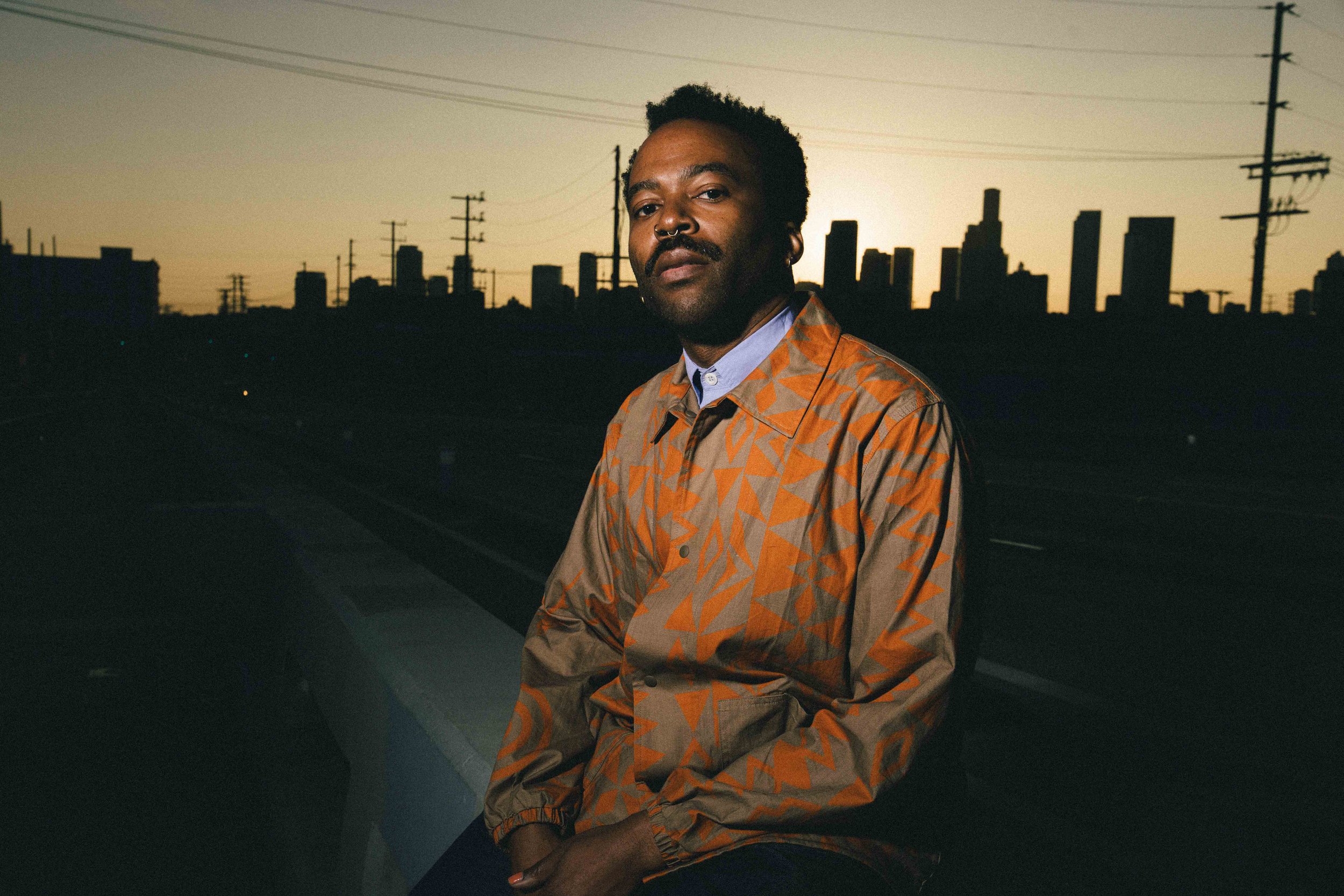
(Photo by Atiba Jefferson)
IARC0116
Josh Johnson
Animative
Out October 23, 2026
A few years ago, the saxophonist, keyboardist, synthesist and musical polymath Josh Johnson was still a fairly well-kept secret in the music world. He was constantly showing up alongside Jeff Parker, Marquis Hill, Jamire Williams, Carlos Niño, Makaya McCraven and others, but often in the shadows, always supporting.
Lately Johnson has been harder to miss. He has helped shape the sound of Parker’s renowned ETA IVtet; served as the producer of Meshell Ndegeocello’s Grammy-winning album, The Omnichord Real Book (2023); co-leads all-star creative ensembles like SML, the Openness Trio and a collective with Sam Wilkes and Gregory Uhlmann; and this year, as the producer of Flea’s Honora and the musical director of his band, appeared on The Tonight Show and NPR’s Tiny Desk. Still, Johnson has yet to bring his solo work fully into the spotlight.
On October 23, Animative, Johnson’s third album under his own name and his first for International Anthem/Nonesuch, arrives to turn up the wattage on his artistry. More than any release to date, Animative shows why musicians and a growing community of listeners know this Chicago native and longtime L.A. resident to be one of the most imaginative electroacoustic musicians today, not to mention one of the most stunningly versatile. On Animative, the harmonically rich, loops-inflected sound Johnson has been developing — first with a full band on 2020’s Freedom Exercise, then on 2024’s immersive solo album, Unusual Object — comes together in a life-affirming LP of lowkey improvised brilliance and technological ambition.
Animative erases any distinction between being a jazz record led by a saxophone player and an experimental electronics record by a solo artist. Effects and digital overlays are at work in more ways than the ear can track, even when what you hear first is an unaltered saxophone sound. Meanwhile, undiluted improvised brilliance on the saxophone seeps in at unexpected moments. Johnson puts sophisticated technologies to work on nearly every track, often using the saxophone to control a sampler or a drum machine, triggering changes in a loop or an effect. But it’s always in service of a feeling — working to escape the trap of mastery. “I'm looking to make it feel more human,” Johnson says.
When running his alto sax through a harmonizer, Johnson is often varying and altering the intervals as he goes, so that the harmonies don’t just move in parallel lines or a single key, but curl and swarm. He also sometimes adjusts the effects on individual notes within the harmonized sound. Listeners to the recent, effects-laden, overdubbed saxophone experiments of Sam Gendel, another Los Angeles saxophonist-producer (including with Wilkes), will note the distinctiveness of Johnson’s approach. Fans of Lea Bertucci, Travis Laplante, and other experimental reed players pushing the structures of solo work will find a similarly rich complement in Johnson’s blend of looping, effects and sax improvisation.
Johnson’s reserved and thoughtful nature made the album’s title something of a puzzler to his friends. “I said the name to a few people, and they were like, ‘Animated is not how I would describe you,’” he laughs. “But I'm really thinking about it from the perspective of causing animation, giving spirit, or connecting with spirit.” He thinks often of the lessons of Wayne Shorter, one of his teachers, who instilled in him a sense of reverence for the mystical, and emphasized the musician’s duty to “conjure and transport.” And as he put together Animative, Johnson also had in mind the West African philosopher Maladoma Somay’s writings, and the “non-Western ways of thinking about time and being” they propose. He was inspired too by Italo Calvino’s inventive, often-dreamlike short fiction. “The way he uses the vehicle of short story is so gorgeous,” Johnson said. “It influences the way I write.”
Animative’s first track, “Idiophone,” which he’d been workshopping through multiple versions in concerts leading up to the recording session, fundamentally reimagines the saxophone’s musical identity. “I’m really interested in putting the saxophone in a different role besides soloist,” Johnson says. “The saxophone is also the drum. ‘Idiophone’ is me wanting to access the feeling of a percussion ensemble.”
On “Aughts Hymnal,” he manipulates the horn to sound more like an organ. On “Strays,” extending the influence of Billy Strayhorn in a futuristic direction, he allows some of the harmonies felt by the listener to remain unplayed. “If you were to go in and analyze it, all those pieces aren’t fully there. But your ear is filling it in, because the feeling is there,” he says. “I’ve been thinking a lot about how, if I want them to be felt, that might mean making them less legible in a certain way, which actually puts the feeling first.”
While he has become deeply affiliated with the burgeoning L.A. jazz scene, Johnson still finds powerful inspiration in the legacy of his Chicago hometown. Of particular importance is the example set by Eddie Harris, who precedes him not only in the city’s saxophone lineage but also as a multi-instrumentalist, composer and 360-degree artistic thinker. “I’m inspired by him as a conceptualist, and somebody who navigates a lot of different spaces,” Johnson says. Among pianists, his pantheon is topped by another brilliant eccentric: Mal Waldron. “In music that is so often centering virtuosity,” Johnson says, Waldron demonstrated “a different way of existing.”
Like Harris, Johnson always leads with a strong musical concept, but he relies upon a collaborative community to execute it. The album’s personnel include Ben Lumsdaine on drums, Macie Stewart on violin, Marquis Hill on trumpet, and Paul Bryan on bass and co-producing the album with Johnson.
While working on “High Step,” a slightly churchy, slightly off-kilter groover, Johnson felt Meshell Ndegeocello’s bass would be a perfect fit. She performs as a guest on the track, occupying the bass chair — a supporting role she rarely plays.
“Mill” is a quieter tune that seems designed to warm up the memory banks—reminiscent of Aphex Twin or Joe Zawinul balladry, or more recently the work of Johnson’s frequent collaborator Jamire Williams—as a clean saxophone sound pairs with subtly processed lines in a mix of unison and harmony. Finally, the last note molders into silence.


Notes
Produced by Josh Johnson and Paul Bryan
Recorded by Paul Bryan in Nashville, and Josh Johnson in Los Angeles & Brooklyn
Mixed by Paul Bryan
Drums on “Reece” recorded by Ben Lumsdaine
Mastered by Dave Cooley at Elysian Masters
Sequenced by Scott McNiece
All Compositions and Arrangements by Josh Johnson (Sky and City Music BMI,
administered by International Anthem Publishing)
Josh Johnson - Saxophone, Synthesizer, Sampler, Piano, Rhodes, Percussion, Bass Clarinet, Guitar, Drum Synthesizer
Paul Bryan - Bass (Close)
Meshell Ndegeocello - Bass (High Step)
Ben Lumsdaine - Drums (Reece, High Step)
Marlon Patton - Drums (Close)
Brandon Combs - Drums (High Step)
Macie Stewart - Violin (It Can Be Everywhere)
Marquis Hill - Trumpet (Upstairs 2021)
Aaron Steele - Additional Production, Sampler (Mill)
Cover Photo by Anna Powell Denton
Design & Layout by Aaron Lowell Denton
All rights reserved
About
Josh Johnson spent his earliest years in Maryland before his family moved to the Chicago suburbs when he was young. He didn’t take to his piano lessons, finding that he was happier teaching himself. It was only after starting to play the saxophone at age eleven that he fell completely in love with music.