

TRACING THE LINES

VOL. 3
Time
is my
Ally
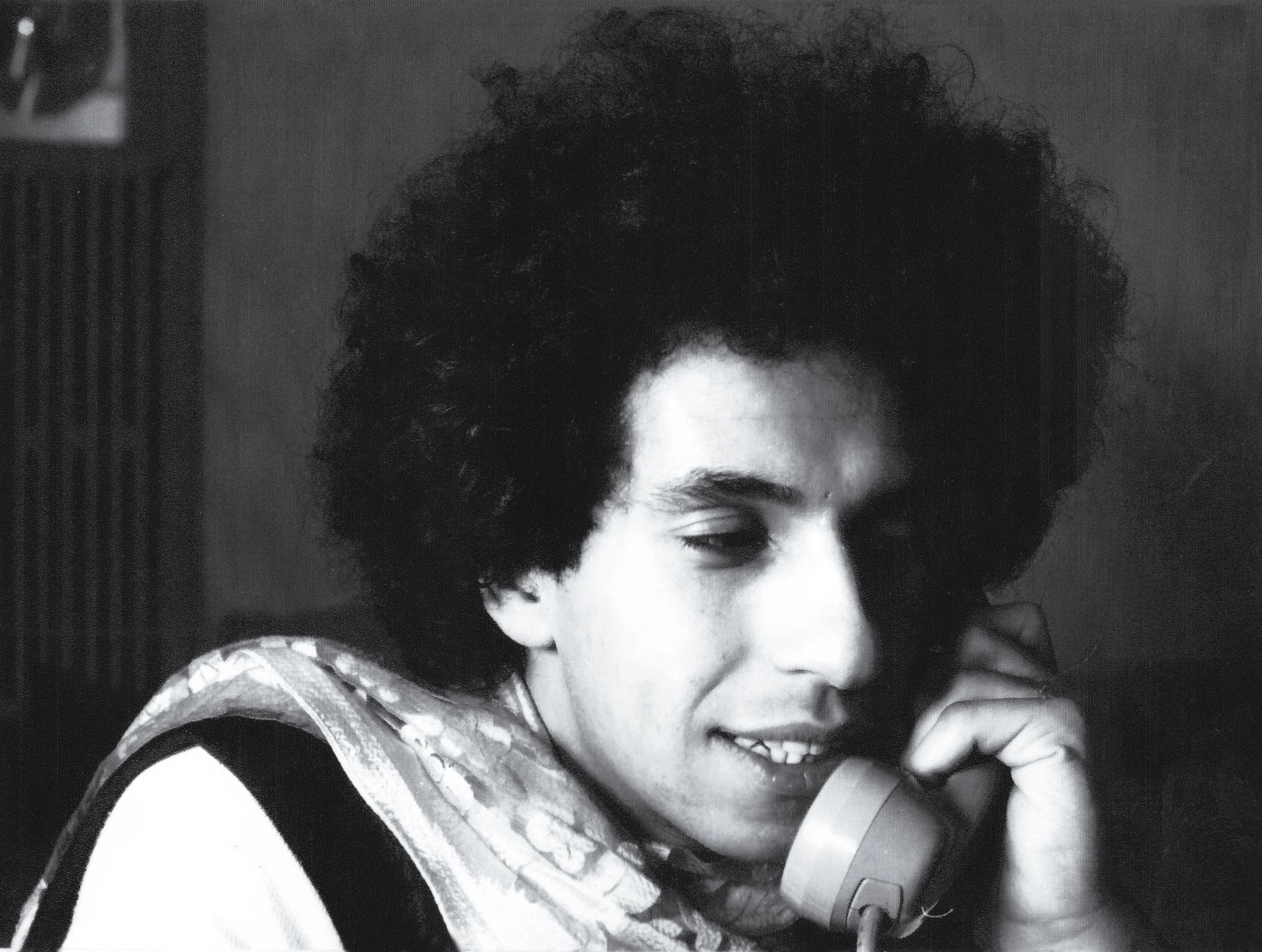
The following is a conversation between the multifaceted French musician Ariel Kalma and LA-based interdisciplinary artist Lani Trock. Followers of IARC are likely familiar with Kalma via his 2024 album with Jeremiah Chiu and Marta Sofia Honer The Closest Thing To Silence (IARC0077), but his discography is vast and storied. His early work in Pierre Schaeffer's oft-lionized Paris electro-acoustic studio GRM is enough to award him a legend badge, and that same spirit carried through the decades to the domestic workspace he kept in his adopted home of Byron Bay, Australia.
Lani Trock’s work deals with the sacred transformation of public space and the activation of these new worlds through participatory experiences, to understand the nature of consciousness and its relationship to the material world. Via ephemeral, site-specific, immersive installations, utilizing human-made, natural, found, and homegrown items, her work seeks to awaken a new operating system for society, rooted in interdependence and collective well-being. In this conversation they discuss their respective workspaces and the ways in which those spaces inform their art.
Ariel Kalma and Lani Trock
In Conversation
ARIEL KALMA
My space is my room. Everywhere I go, I create a corner, or a room, or something where I can feel homey. This is what I want. So, my room is this, where I can feel I'm home. Because I don't want to be in foreign places where I feel strange, like a recording studio. I've been in recording studios, of course, but this is what I want to create in my life. It's a corner, it's a room. It's a space where I can create. What about you, Lani?
LANI TROCK
I really resonate with this feeling of space. The creation of it. The way a place feels. It might be in a different place, but I like thinking about how to create that feeling of home and safety. Sanctuary. That's something I'm really interested in. I think there's this intangibility, this quality that you're describing. It's ephemeral in nature and may be something that we're creating every day as part of our care or stewardship of the space. That feeling reveals itself through that process.
AK
I see you create mobiles. I created this one. [moves camera to show the piece]
LT
Oh, beautiful! Oh, I love it.
AK
I made that 50 years ago. [laughing]
LT
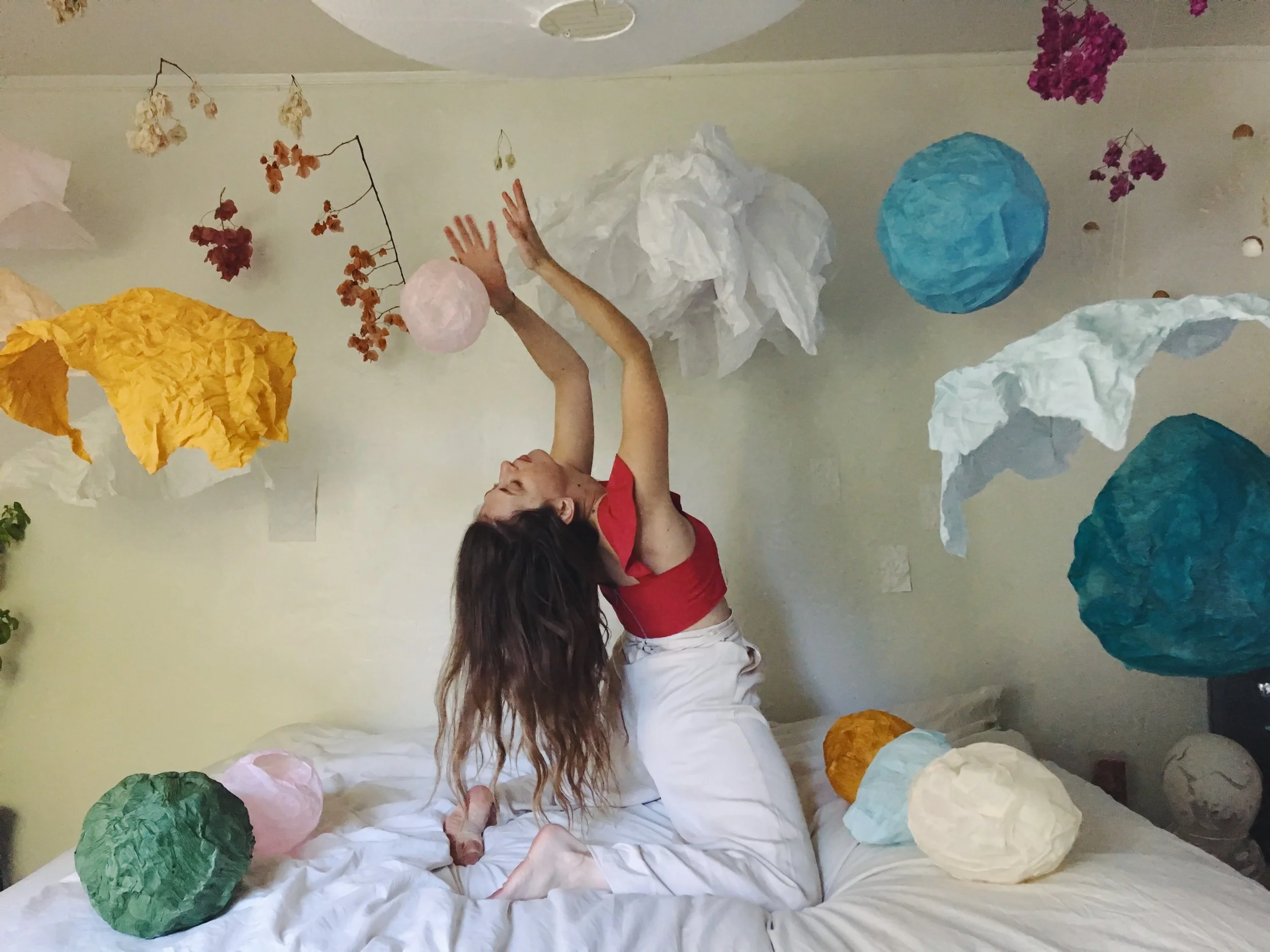
Wow. I have one right here too. This is a branch from our orange tree. The landlords had cut a big section of the tree off because they were afraid it was going to hit the house. And I kept it, and I made this mobile from that branch.
AK
Yeah, it's wonderful. So where are you? In your room?
LT
I'm in my art studio, which is in our garage.
AK
Okay. Okay.
LT
Yeah, I have lots of little objects and living things. There's a little bit of chaos in mine right now because I've been in what I like to call "project mode".
AK
Of course, of course!
LT
I had a busy spring. But yeah, this is my life.
AK
My life is a project.
LT
Yeah! [laughing] Oh, beautiful. I think it's really helpful to think about life in that framework – as a practice or a project, rather than trying to get to some predestined outcome or destination. As they say, enjoying the journey of becoming.
AK
When you create installations, where do you go? How do you function?
LT
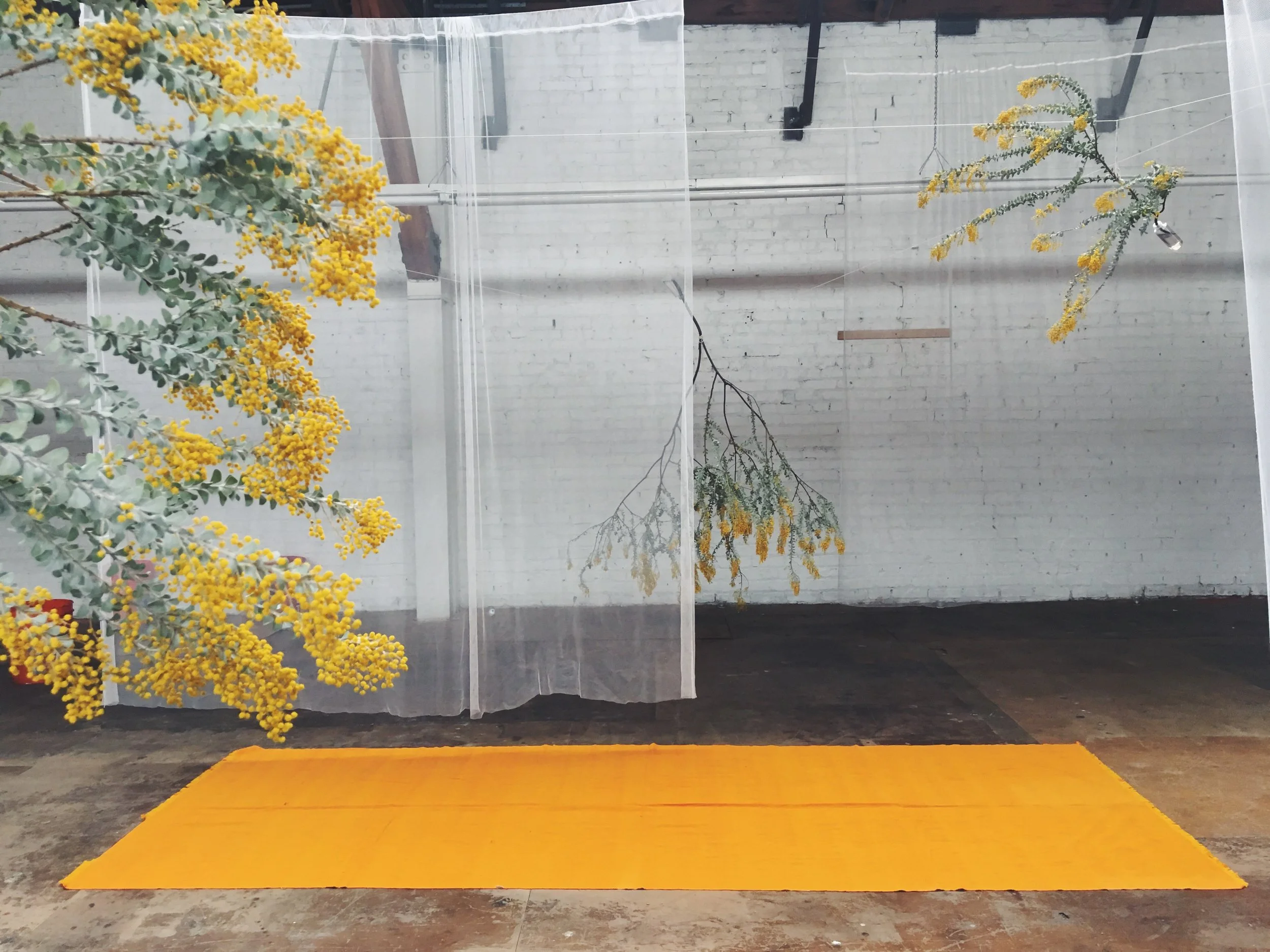
That's a beautiful way of phrasing it. Much of my work has been site specific. So, I'll be invited to make an installation as part of an exhibition in an art gallery, usually. Or something of that nature. So I'll go and visit with the space and see what's on offer. What are the conditions and limitations, or rules of that space? I work often with a collection of assorted objects. Some that I've made by hand from clay or paper – other natural objects – and also collected vases. And then I work a lot with living, or once living materials like plants. So I will forage different flowers. I grow and I am really interested in propagating plants, like making new plants from other plants. I save seeds and I'll grow new plants out of plants in my garden, or that are in my studio already, and incorporate them and create these living gardens as installations.
I would say the primary intention for me in this art practice is to be a cultivator of peace. To create a space that is peace.
AK
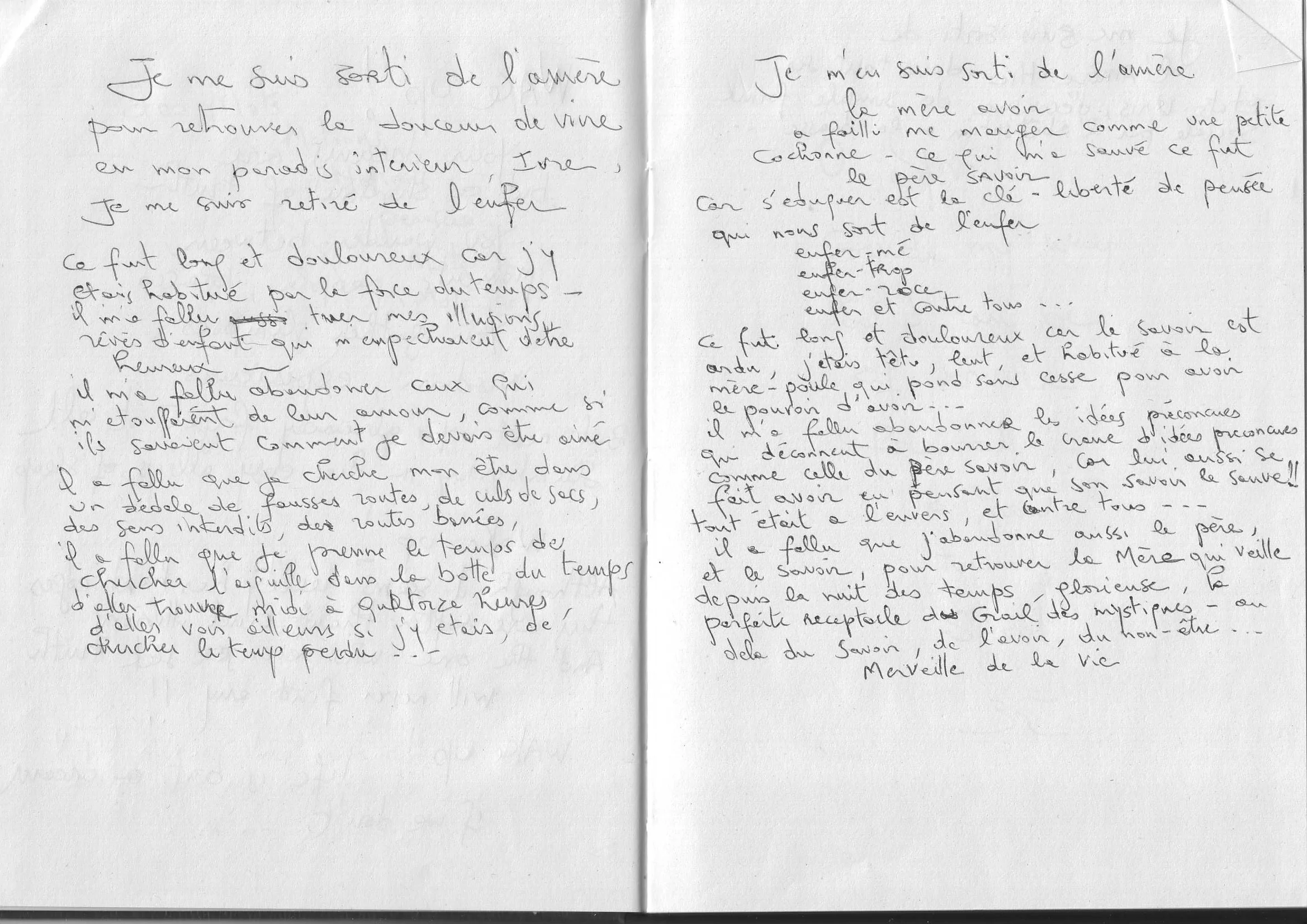
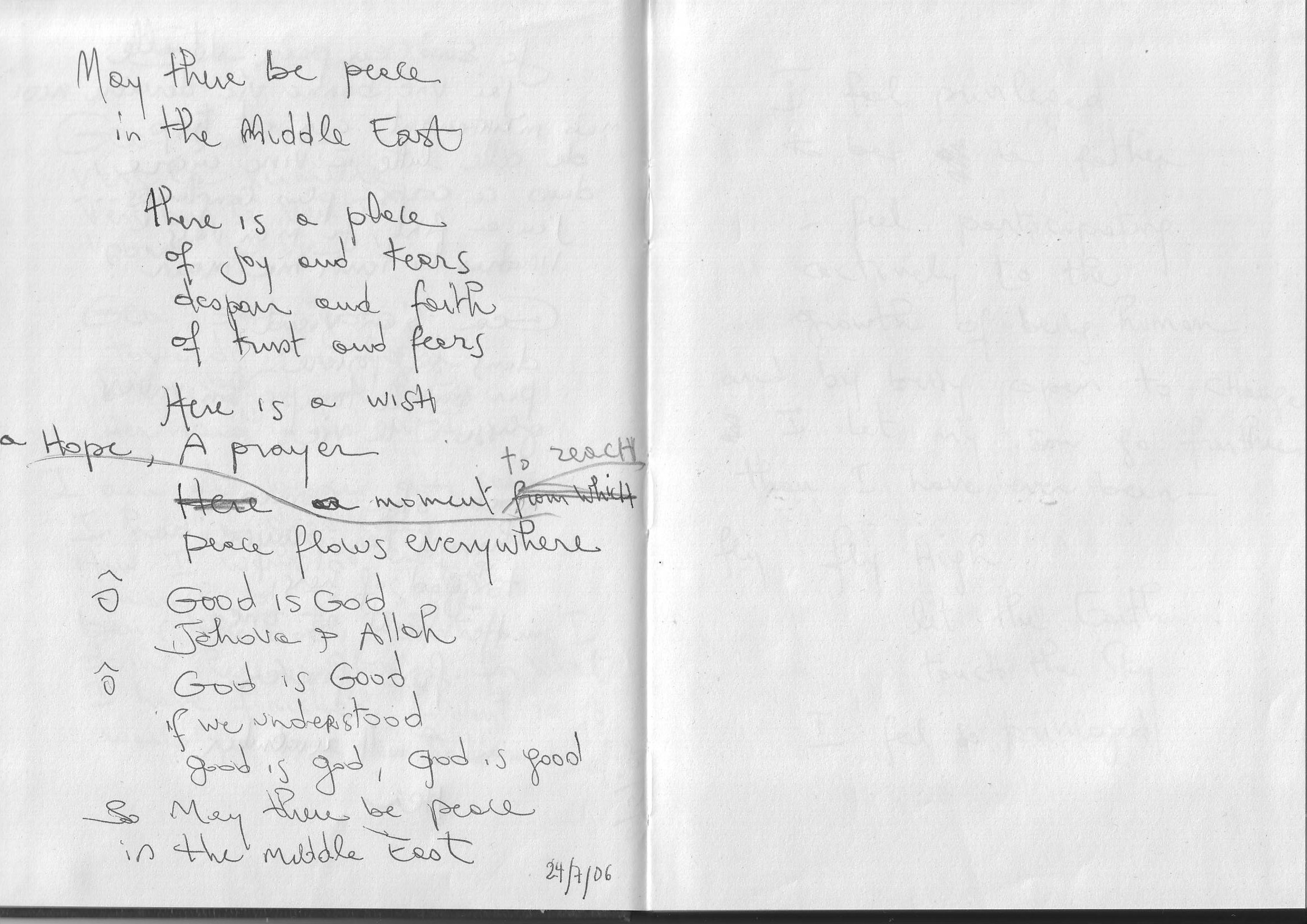
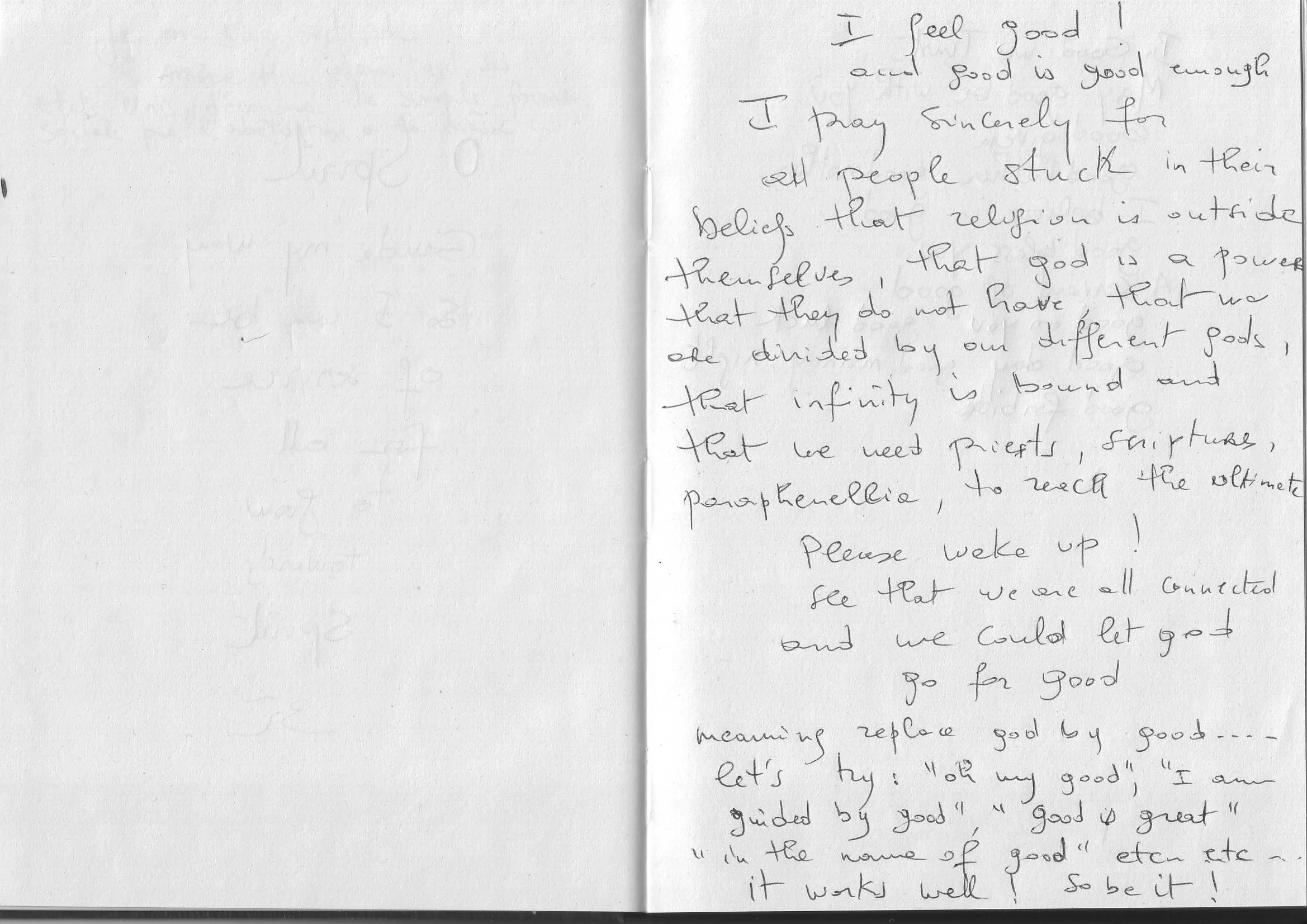
Well, that's what I create in my music also. Cultivator of Peace. I like that expression. Recently I made a poem, which is called "Peace in the Middle East".
LT
Would you share it with us, Ariel?
AK
Yes. I'll find it.
[rummaging through papers, etc]
I have no idea where it is.
[quietly, while searching] …may there be peace in the Middle East. Allah, God, Jehovah.
I can find everything else, but not this one...it'll come. It is short and potent. That's what I like. [pause] I want to share something with you! I love to make things out of something. Like you!
[Ariel and Lani spend some time showing each other various stones, bottles, and natural items. Laughter, smiling, comfort.]
LT
I wonder if we could speak a little bit about your relationship to spacetime.
AK
Spacetime. Yes. Good question. Okay. Okay. [long pause; slowly]
I was born in space. Time is my ally.
The galaxies and the comets and the stars are in my composition.
I always try to leave space and time in my compositions. I don't know if I can live without space and time. And although I am limited in time [laughing], I want to have a lot of experiences. So I leave footprints in the sand for children and grandchildren to explore improvisation. Because all my music is improvisation. I don't have notes. It's all in my head. What I create is what you get. I always was like that. I never learned – I tried to learn music – but it was not possible for me, intellectually. I could not create music with notation, but I hope I succeeded. And what about you?
LT
For me, the answer is yes. You've been successful. I very much enjoy listening to your music.
AK
Thank you.
LT
And I can relate to the sentiment that you've expressed of, let's say, a challenge in trying to adhere to a specific way of doing things, or a formalism about things. I think I started to feel greater artistic resonance once I let go of some of those preconditions or ideas of how I thought it had to be or how I had to be, and to just give myself space and time to explore and improvise and intuit my direction. That what's emerged since then has felt much more resonant for me, much more harmonious.
AK
Intuit… [sly smile] when you intuit you are into it! [both laughing]
LT
Certainly! [still laughing] Agreed. [regaining composure] So, with this formlessness, this ephemerality, or this improvisational nature to your artistic practice – how does that relate to your day-to-day life and how you live? Do you prefer a regular schedule and structure? Do you like to have more openness and space and things to be emergent?
AK
Well, now I have grandchildren. Space and time is very, very divided with the grandchildren. So I don't have a schedule. I go with my intuition. So if I have time, I practice. And generally I record my practice because I've learned to make quality recordings. I'm quite good with this, and I don't need much. I need to go in my head and start. Maybe it's the same with you. When you go into an empty space, how do you create an installation?
LT
Deep listening to the space. I find it to be a conversation or a dialogue with the space, with the objects, with the plants, with myself – my inner most self. And to create, I seek to cultivate a clear channel for myself to listen and receive what wants to come through me. I find that if I try to direct too much intellectually…
AK
[sympathizing] No, no… [laughs]
LT
But the more that I listen the better I can hear what wants to come through me.
AK
Same, exactly the same with me. I work a lot with drones, and drones are a form of music which have no special characteristics, but after a while it wants to do something. And I jump.
LT
Are you recording in analog or onto a computer? How do you make these practice recordings?
AK
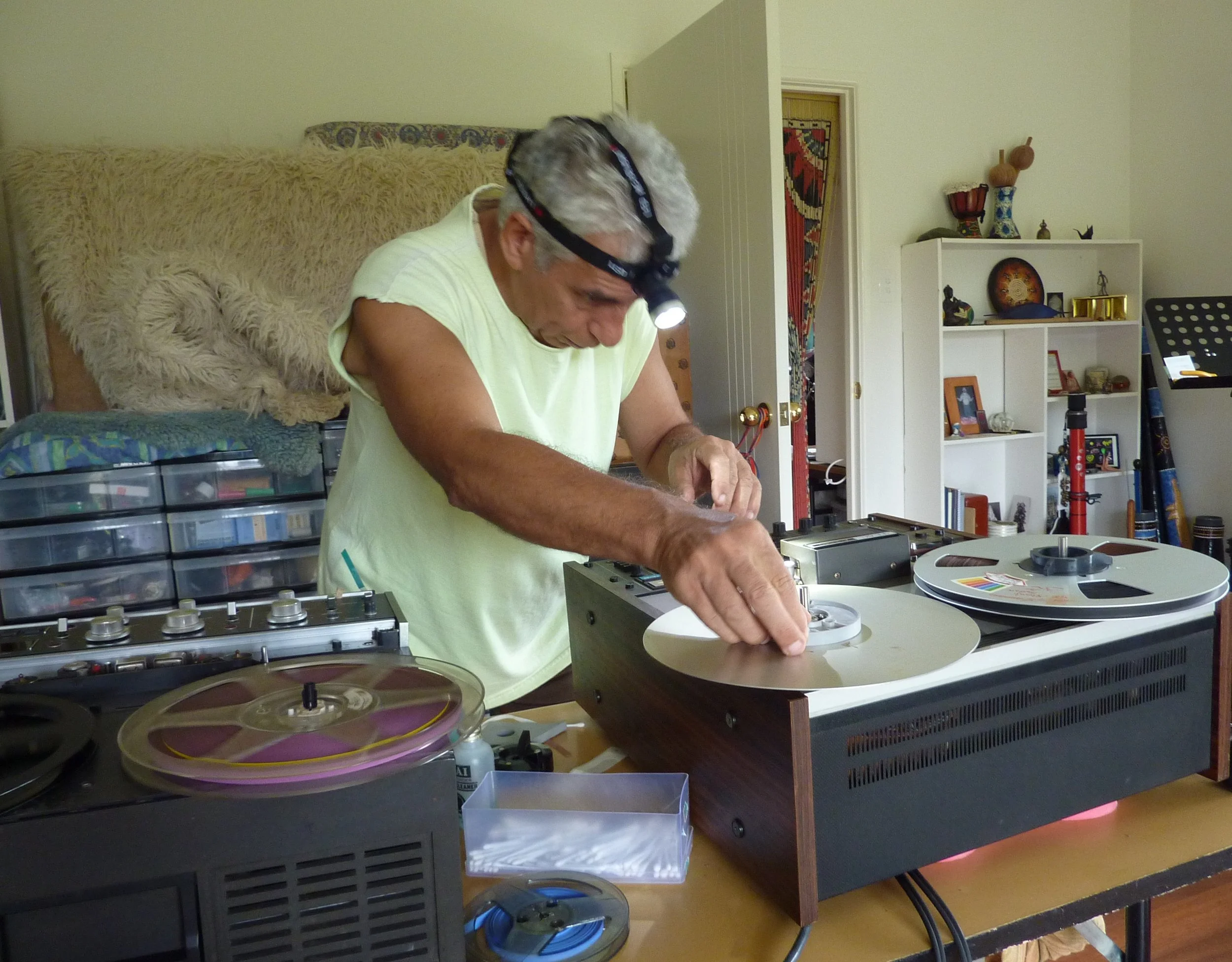
I'm an old school person, so I started with a tape recorder. I had a lot of tapes.
LT
I can only imagine.
AK
And they were expensive, so I had to really choose what I wanted to record. I had a friend who was a technical director in a recording studio [GRM, Paris], and he gave me lots of tapes. Sometimes I had to erase part of it, or the whole thing, but I had tapes. So I recorded a lot.
LT
I also have a sub-question about your archival process. What have you done with all those tapes? Do you have them still?
AK
My friend – who was a childhood friend, my oldest friend, actually – kept those tapes in his garage for 40 years. Once I was installed in Australia, where I live, he sent me those tapes and I had many, many surprises. It was a gap of 40 years! So I had those tapes and I digitized them and made them clearer. The result was that I had 150 hours of recordings, and I made albums one after the other.
LT
So do you go back through this archive and pull new material to make work with now? Or do you work with things you've recorded in the past for records you're putting out now? Is that how you release new music? And do you layer on new things that you're recording now with things you recorded many years ago? Or do you keep them together within their own era of recording?
AK
Well, it's a mix. I have some tracks which I want to mix, to assemble with new tracks. I can't give you an example because it's too early in my day. [laughing]
LT
I think this is one of the most interesting, let's say, practical dilemmas of being a lifelong artist. You amass this body of work that you need to actually store either physically or digitally, and manage the archive of it, and maintain it. It's a whole other dimension to making work as an artist. This lifetime of work.
[long pause]
LT
Do you make space to do nothing? To just rest or not do anything? Do you like to just sit still and do nothing?
AK
Yes, I do. I do. Every morning, my wife and I, we do meditation. And sometimes I dream. I daydream. What about you?
LT
I treasure that space. I also have a meditation practice. I find that the more time and space I'm able to give myself at the start of the day to engage with that, to engage with silence, and also, again, deep listening to my inner-self or my inner-knowing – the still small voice within – the more I can tune in to where to focus myself in that day, and feel in harmony with the rhythm of life and the waves that come.
AK
Beautiful, beautiful. If you listen deep
within you will find immensity.
[very long pause]
LT
That resonates deeply. I wonder if you might speak a little bit on how you approach spaciousness versus fullness within your musical creative practice. Where there is space. Where there is sound. Maybe the answer is primarily intuitive, but how do you approach the creation of music and that balance between those rhythms?
AK
It's an interesting question. It starts with anything. So for example, I have something recurring in my head, which I have recorded a long time ago, but it's in my head. So, it's like [sings melody] a repetitive mantra or something like this, and I build on this. And then I make variations and I record one after the other. I try to find it: What is it? How do I create music? Yeah, very simple. [laughing]
LT
We were talking about it a bit earlier, but I think we maybe diverged slightly. Do you still record onto tapes or now you do it digitally?
AK
Oh, I've dropped tapes. Sorry, sorry! [laughing] I have dropped everything which is not digital. I transferred everything which was on tape. You should have seen me! I had two tape recorders in my room. It was intense work for two months. Some tapes were molded and I had to clean them by hand. I'm still working on the archive which I have created.
LT
That's such a loving act of devotion.
AK
It is! Loving acts of devotion! A loving act of spirituality.
LT
Do you like working on multiple projects at the same time, or do you like to finish one thing and then move on to the next?
AK
I work on many different things. Sometimes I like to work on one specific song or project, but many times I work on several at the same time.
LT
And could you describe the feeling when you know the work is finished. When it's reached completion, how do you feel? How do you know?
AK
That's it!
LT
[laughing] It just is.
AK
It's like [tracing the air with both hands, forming a circle] that's it!
There is not one note which would appear on
this recording, which would not be welcome.
LT
I relish time and space to simply be in the studio, and to organize and tend. To care for the living objects that are here. To sing and make music, and to become one with my surroundings. To come into a flow with everything around me. At my best I want to act as a channel for divine inspiration. I hope to be in a mutually beneficial collaboration with everything and everyone I'm working with. I seek to create embodiments of care and well-being. Peace. I hope, always, to create peace in my work in the world. To create beauty. I find immense value in the experience of beauty, not as a superficial aesthetic, but as a transmitter of the feeling of being at ease and at home in the world.
AK
[shifting] Harmony versus Chaos…what do you have to say about this? I find Chaos is part of the entropy of the world, and Harmony is the contrary. So how do you find it influences your work? Chaos is part of life, like Death is part of life, but Chaos is part of the disruption of Harmony. So how do you work with Chaos?
LT
Chaos...oh, that's such a good question. I think perhaps it's foolish to think that I could resolve all Chaos, and maybe that might be my first inclination, to say that the resolution of Chaos is Harmony, right? But I think maybe the beauty of being a human being is learning to flow with the Chaos and to channel it into harmony without forcing it or even condemning it, but rather honoring it as a part of the process of our collective becoming – that the existence of Chaos is an instigator of transformation. So I think in my highest, most attuned self, I can perceive challenge or Chaos as a portal to transformation and evolution. An essential piece of the process of transformation and becoming. Not working, or not feeling right is part of what makes the resolution into a harmonious outcome so satisfying or fulfilling.
AK
Yes, yes, absolutely. For me, Chaos is part of the creation. Before I finally – and I emphasize finally – sit down, and it's quiet, and everything is ready, and the microphone and the instruments are working, there is this Chaos inside of me. And, gradually, I find myself in Harmony and I dwell in that. And finally the creation is made.
LT
Yeah, I think it's essential. I'm also really interested in group improvisational settings. I find that that's when some of the most beautiful outcomes can emerge, but also it has the potential to be the most Chaotic because you absolutely cannot control it. You can set the conditions and do everything you know how to do to skillfully prepare, and give instruction or guidance to your collaborators, but not too much! [laughing] You set the stage and you invite the players, and then what can emerge in that space can be the most moving magic, beyond even what the mind can individually conceive of.
AK
Absolutely.
LT
But the Chaos may also ensue. It's really interesting, especially working collaboratively as an artist, learning to let go and be open to the Chaos. And to accept it and not judge it. If you're in this process in the studio, for example, in a more formal environment, and you have players that know their parts and they're recording this pre-written music, you have to get it right. There's this mentality about it that's so precise. But I think, at least for myself artistically, I'm much more interested in bringing this decentralized, collective intelligence into collaboration and just kind of seeing what happens by bringing together people that I love and respect and resonate with energetically, and then creating a safe space for us all to share our gifts together. That tends to yield the most exciting results for me.
AK
Absolutely. I shook my head yes in approval several times.
LT
When did you start to identify as an artist? About what age? Did you have a moment where you were like, I'm an artist. I'm going to be an artist. How did your professional identity evolve in the earlier part of your life?
AK
You see, I'm an amateur! I love music, but I'm
not attached to the results of music.
For example, I spent years not playing music, or playing music only with my saxophone and doing meditation work and…
LT
Making sculpture?
AK
Yes! It's a vast subject. I've spent lots of time writing too. I've never been interested in the commercial value of music. I've always tried to respect myself. I was a professional musician going on tour, but then I would drop it. I would drop it because it did not respect who I was. So I remember doing free jazz and then dropping it. Just stopping. Because the jazz clubs…those caves! [shaking head] And so I dropped it, and then I spent years doing meditation work, and I was with a group of people who were interested in learning to be a better being.
LT
Was that an organization or was just an emergent group of people that were gathering under that shared intention?
AK
Well, there was a group leader who taught us many things, such as Tantra. He taught us how to be loving, and to respect ourselves, and to be better beings. So, how do you respect yourself? Well, you respect yourself by refusing to adhere to fixed thought. Somebody might say something and then you balance yourself and you realize, no, I don't want to do that. So you train yourself by being yourself. [both laughing]
LT
Do you have any guidance or advice for young people who are seeking to be themselves more in the world?
AK
Meditation. Meditation is the key. In silence you find everything. So be quiet. Just be quiet.
[ON GRM STUDIOS, FRANCE]
Ariel Kalma: My friend who kept my tapes was the technical director at the GRM. He found me a job when I was coming back from India, and was a bit lost. He found me a job as an assistant recording engineer at the GRM. It was great because I had to deal with equipment that I knew and I did not know, and to learn the studio itself. And once this was established, my friend would call me during a weekend when there was a cancellation. So the cancellation would mean that I had to bring everything from my home to the studio, which was on the other side of Paris, and close the door and be completely alone. I could not answer the door. [laughing] I had to close the door. So there were a lot of recordings which were made during that time which were fantastic. For example, I recorded singing bowls that I brought back from India in 1974. And it was really amazing to hear the quality of the recording. I made so many recordings there.

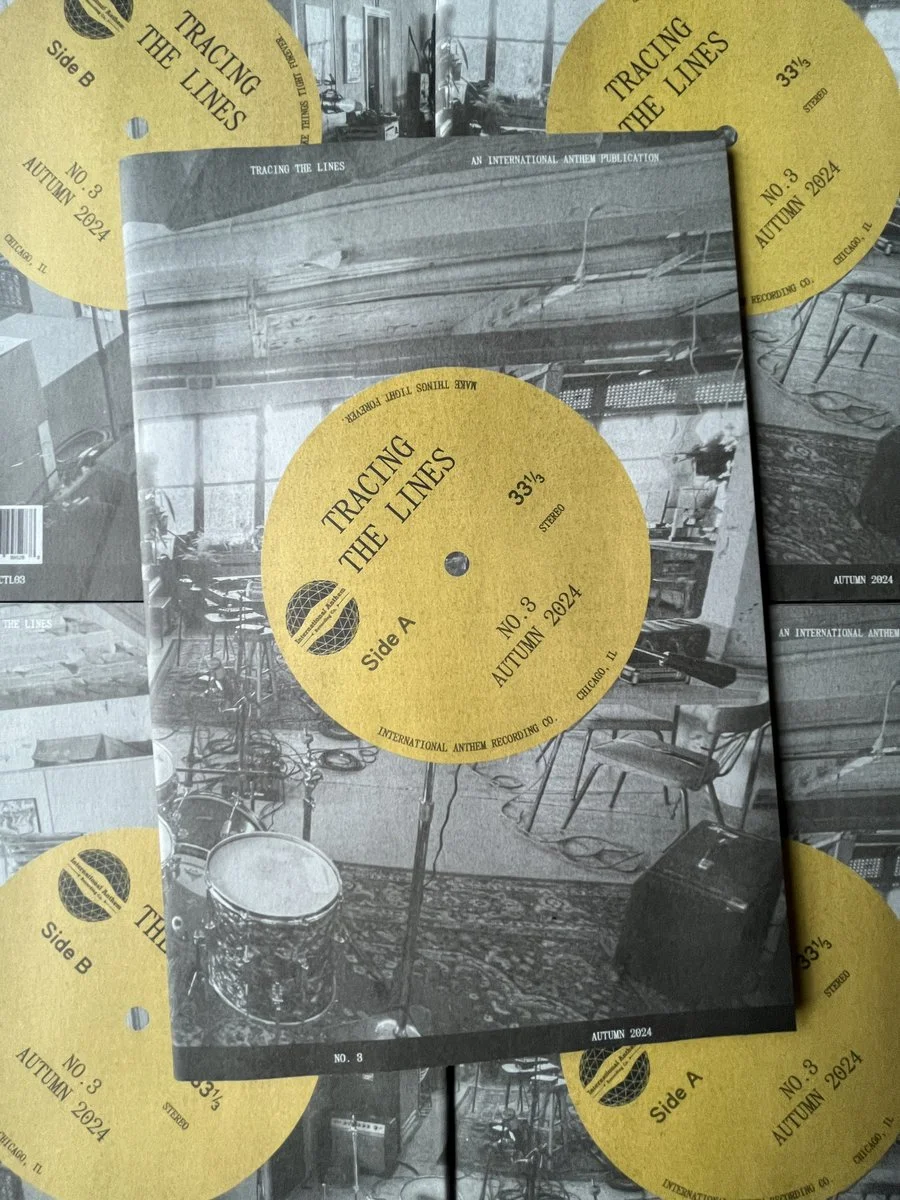
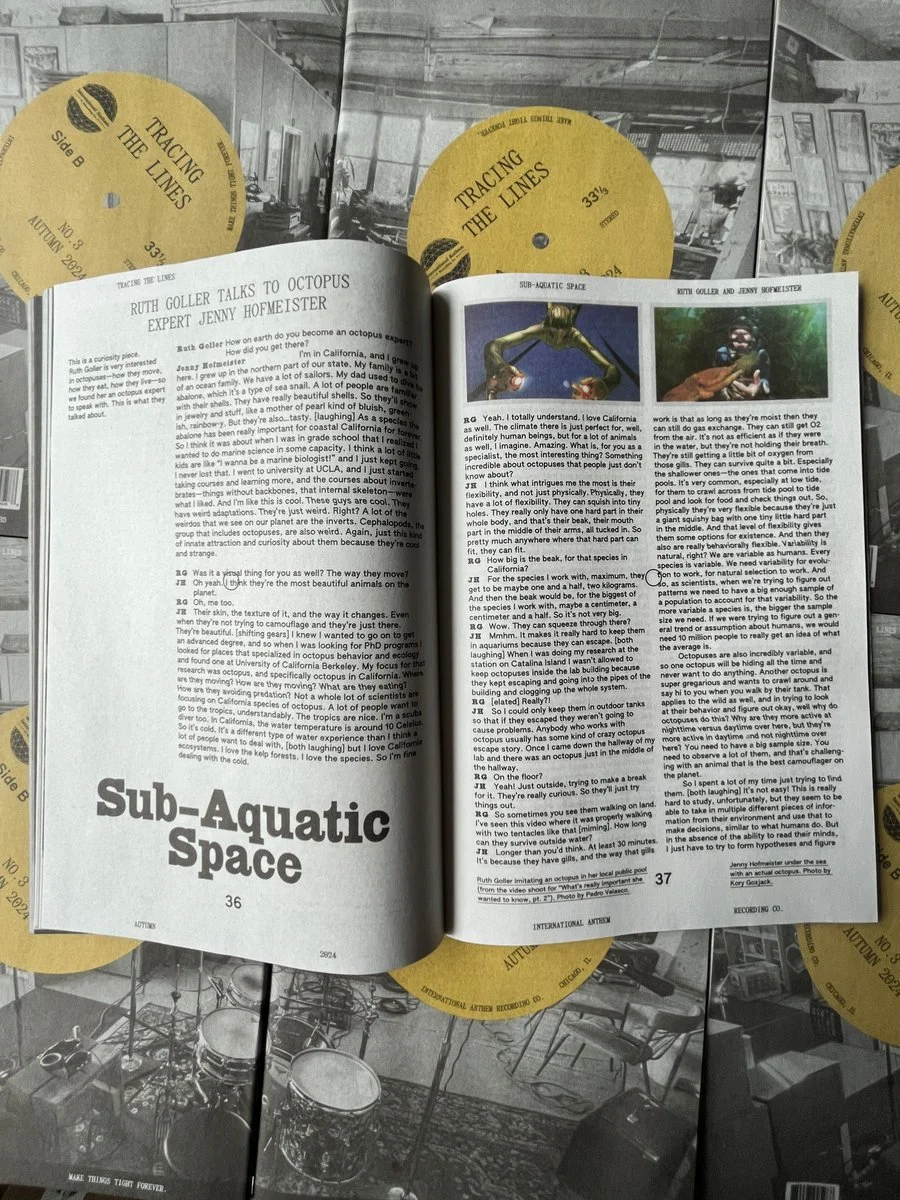
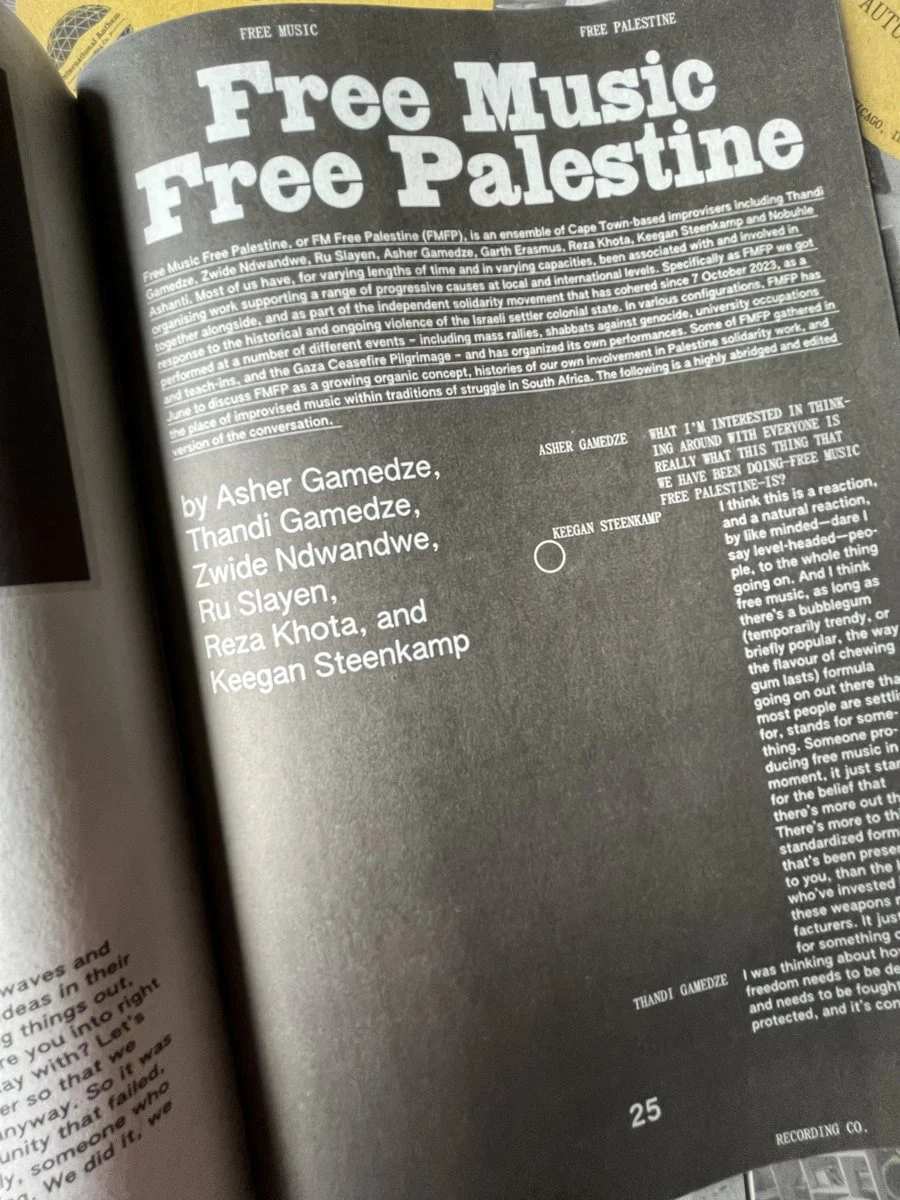
Tracing The Lines is a creative exploration of International Anthem Recording Co. and the community that surrounds it.
Issue #3
88-page 170x250mm newsprint zine, printed in CMYK on 55gsm stock, edited by David Brown and designed by Jeremiah Chiu