
Tracing the Lines


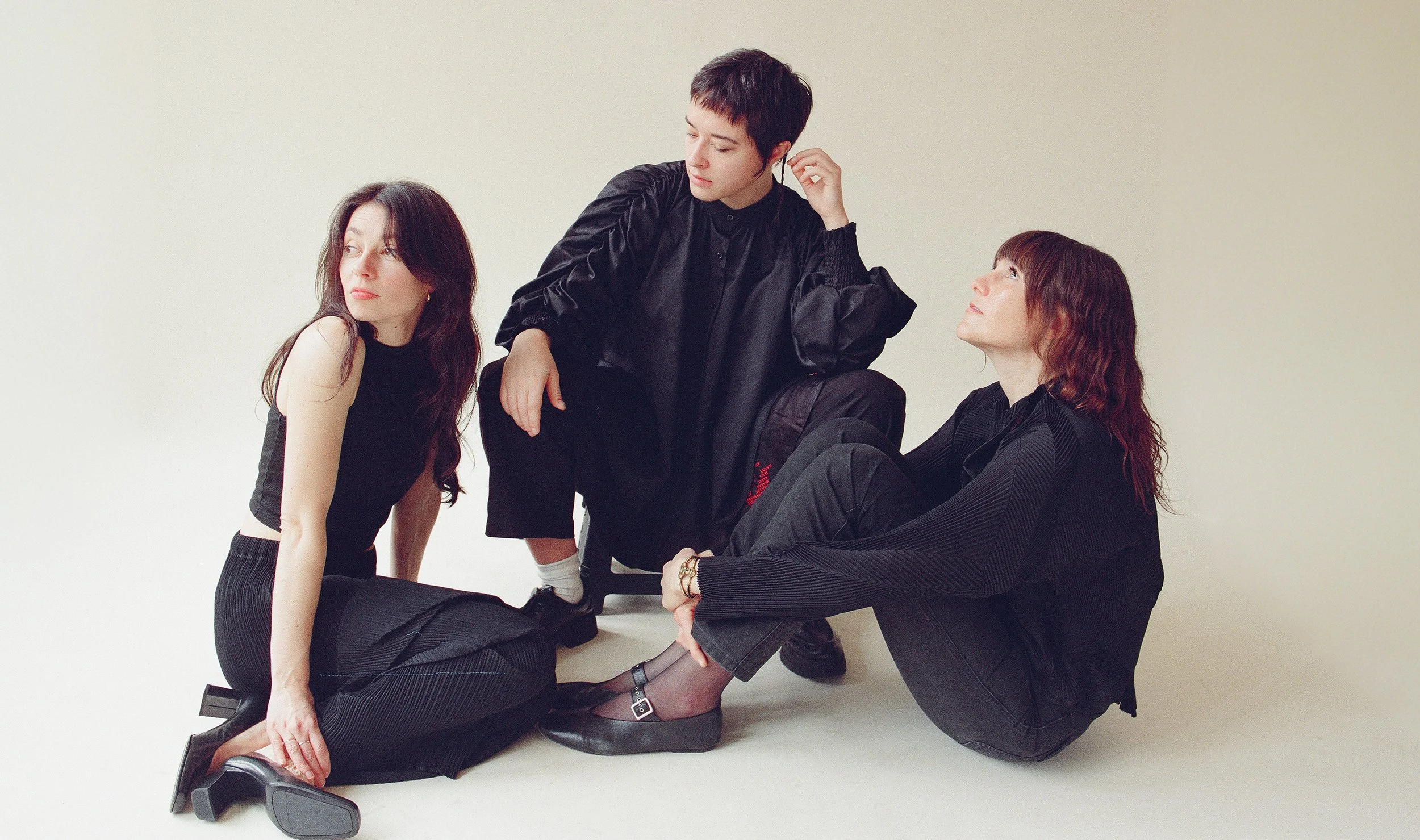
Image by Leah Wendzinski
TRACING THE LINES
NO. 4
A Conversation With Yuka Honda, Whitney Johnson, Lia Kohl, and Macie Stewart
The following is a long and freewheeling conversation between Yuka Honda (Cibo Matto, eucademix, Plastic Ono Band) and the trio of Whitney Johnson, Lia Kohl, and Macie Stewart, covering everything from early 90s NYC, improvisation, and communication styles to cycles of nature, cooking, food justice, studio days, and more…
Contemplative pace setters, droning doom excursions, melodious wisps on the wind, and more—selections by Whitney Johnson, Lia Kohl, and Macie Stewart. Have you connected to their album BODY SOUND? These sounds might be for you...
Playlist also available on Spotify here.
Yuka Honda:
I'm loving your album very much. I listen to it all the time. It's great. I’m excited to feel that young generations are making such beautiful music.
Lia Kohl:
Oh, thank you.
Yuka Honda:
It makes me feel old to say that, but...It's cool. What inspired you to make this album?
Macie Stewart:
We've been playing together since about 2017, improvising together, but it was always very sparse. We'd play one gig a year, but every time we did it, we were like, "this is awesome. We need to do this again." And so I feel like something clicked two and a half years ago where we were like, "let's try to make this a thing, because we've been enjoying it so much every time we get together and just improvise. So let's see what happens.” Lia and Whitney have a duo project together. Me and Lia have made some records as a duo together. The three of us have recorded on different projects together. It just felt like it was time. So the inspiration legitimately was just like "we love each other and what happens when we play and improvise together, so what happens if we translate that to making a record?"
Yuka Honda:
That's awesome because it definitely comes through from the album. I don't want to say love because, I don't know, it's an overused word, but there's a trust. Something that's really beautiful that comes through, that's more than a note or...it's more like an atmosphere thing. And I really love listening to it.
Macie Stewart:
That means a lot because your music is so special and important to us all.
Yuka Honda:
Thank you. But I don't really have improvisation buddy like you guys have. It's really cool. You live also close to each other, right?
Lia Kohl:
Pretty close, yeah! I think it's funny when you're younger, you think that sort of close connection is endless, that all your life you just meet people and you have a wonderful connection with them, but actually it's kind of a rare and wonderful thing. I think some of the trio coming together was realizing that this is really rare and special and that we should go for it because it doesn't happen every day.
Yuka Honda:
That's awesome.
Lia Kohl:
Did you ever have someone who was like an improvisation buddy?
Yuka Honda:
I guess I did when I was younger. In early 90s in New York I had lots of improvisation buddy. Also, New York was very cheap, so nobody was working, really. None of us really had a real job. We just worked every now and then when we needed to. We had a lot of time to hang out. A lot of us had a music studio situation, or shared situation, and we would also stay up all night and bike to friends' studios and jam. We did lots of improv shows in the early 90s. I remember it would be like two, three dollars to get in and we just had shows like two, three times a week. Maybe that's exaggeration, but it just seemed like it was happening all the time. And it seemed like it was a very natural environment. I don't know if maybe young people in New York have that today. [pauses] Every time I say “young people” I feel like I'm an old...
Lia Kohl:
No, no, no, no.
Yuka Honda:
But it's harder in New York. Things are expensive, life is harder. It's not so easy to just get together and jam. I do miss early '90s New York, where things were a lot more easy. The entire city just kind of felt like a big dormitory and you walk around and you run into your friend musicians and you go to their house and you jam. You listen to music and there's a lot of musical time.
Lia Kohl:
Sounds really spontaneous.
Yuka Honda:
Yeah, it was very spontaneous.
Lia Kohl:
It's hard to maintain that kind of feeling of spontaneity, for me. Because everything is so planned.
Yuka Honda:
Yeah. Everything is fast. So now we have cell phones, which made our life very convenient, but also it made our life chaos in a way...
Lia Kohl:
Sometimes convenience is actually the enemy of creativity.
Yuka Honda:
Yeah, it's true.
Macie Stewart:
I agree. I do feel like there is this element of boredom that is missing from a lot of our lives, which ultimately is what results in creativity, and getting together with people in person and just making a thing together. It's like, if you don't have this open space...like you said, our brains are always occupied by the phone. We can do whatever we want, which is a beautiful thing. We can get together spontaneously via phone, but then we lose this element of time, where we don't just have open time to randomly get together. Maybe that is true youth, but I also think that it's something else. I don't think it's just that.
Yuka Honda:
Yeah. I mean, you said the word “boredom.” I think boredom is so important in many ways. Boredom is also dangerous because it can generate anxiety, but all these things cook in your mind and create something. Then it's so nice that you have friends to share it.
Lia Kohl:
Yeah. It would be interesting to try to create moments of boredom as a group.[all laughing] That's something that I do in my own practice if I'm feeling stuck or need inspiration, whatever inspiration means. But it would be interesting to try to do that collectively. How can we get bored together?
Macie Stewart:
I like that idea a lot. Something that I really appreciate about Lia and Whitney and making things with you guys is that we all appreciate space to a really deep degree. Space in music, but also space in our minds, space in the world. And that's something that feels really, really special about this collaboration, because then it allows for these really playful moments to pop up. Our brains wander into really weird spaces that otherwise we wouldn't get to if we were just constantly trying to occupy it. But yeah, Bordom's important.
Yuka Honda:
With real friends, you can get together and be bored together. I think that's the sign of real friendship.
Macie Stewart:
I think you are right, Yuka.
Whitney Johnson:
Sometimes that happens when you're traveling too. The time when you're spending a lot of time in the car is a type of boredom that can be so creative when you're touring together, or whatever the mode of transportation is. It's like you're reading, you're talking about what you're reading, maybe you're imagining things staring out the window too.
Yuka Honda:
Yeah, and listening to music. Do you get together and listen to music together?
Macie Stewart:
[long pause] No, but we should. [all laughing]
Whitney Johnson:
Yeah!
Lia Kohl:
I think we'll have some opportunities coming up on long car trips.
Macie Stewart:
I do feel like listening to music together is totally a tour activity for me.
[to Yuka] I wanted to ask you a question. When you are creating a performance and creating a piece, where do you begin from? Because I feel like I've seen you perform so many times and I'm always like, "What the hell? How did she do that?" I feel like I'm always so moved by the things that you make and I'm just curious what the seed of it is. Or if it's different for each thing?
Yuka Honda:
Well, I think I'm always chasing certain feelings. I wasn't a musician for a long time. I started to play music when I was 26 and Cibo Matto happened in my 30s, so I had spent a lot of my youth not being a musician. Just a music fan. I didn't know that I was going to get into music. I think what really inspired me were the theaters and movies and books. I really like experiencing the story, and I like the stories that drag me through this world that I don't know, creating this feeling in me—surprise or happy or sad or confusion. And I think this is the feeling that I'm chasing when I make music.
When I was younger, I thought I would become a writer. I was really into books and I really loved writing, and I kind of lost my writing thing when I came to America and I started to have to speak in English and write in English. I'm losing touch in my Japanese and now I’m in this between-state. I speak both languages, but neither of them feel like my real language. It feels like my emotion is my real language. And that's kind of what I try to do with my music, is to kind of write a novel, but in audio. So I just start with sounds that I like. It's also a lot like cooking for me. There's always an ingredient that I'm into.
Lia Kohl:
Yeah, totally.
Yuka Honda:
So for example, right now I'm really into certain herbs. I'm really into curry leaves and kaffir lime leaves. I found a store that sells them fresh, so I'm just exploring all the food that I can make with these things and the more I make the more I learn the flavor and what it makes me feel and what I like it with. And that's the kind of audio experiment that I do, just trying to combine things. I didn't study music. I mean, I took a little piano lessons, but I didn't really learn the logics. People have taught me some music theories, but I really try not to think about any of this—all the things that I learned after becoming a professional musician. Such things as categories or anything like that. I really try to forget all of it and just kind of go in as a child, experiencing things and combining things without having any thoughts of them. Even though I do kind of get off mixing things that are not supposed to go together.
I really like to have surprising elements in my music storytelling. I need to create some kind of surprise or unexpected thing. I like a little bit of a labyrinth. Basically what I like to tell in my story is that things are not what it seems. I like to create one world and then go to a completely unexpected world from there, but as naturally, as smoothly as possible. Those are things that I'm thinking about, but most of the things just happen intuitively. I think about it afterwards, trying to analyze why I do what I do, because I have to talk about it in interviews and stuff.
I try to analyze, like, "Hmm, why am I sounding like this?" And then I think “this is what I'm doing.” But when I'm doing things I'm not thinking. I'm just feeling it, and then I listen. I record it and I listen to it and then I see where I should edit, where I should shorten it. This is too long or this is too short or this part doesn't make sense. I want to bring in a little bit more meaning, or I want a part to be more blurred, and I want to take meanings out...so I go through layers.

Lia Kohl:
You're talking about being interested in being a writer, and thinking of your work almost as a novel.
Are you ever thinking about it super narratively? Like, with characters or a storyline in your mind?
Yuka Honda:
No, actually I don't think of a storyline in a way that you read a book—like “she went downstairs and there was no one.” I don't think like that. I think I'm recording the feeling of “you go walk downstairs and you found no one and you were supposed to see someone there, but there was no one, and you'd feel like OH!”
I feel when I hear sound. I feel a lot of things. So I'm creating this emotional story, an internal feeling of the protagonist or whoever is experiencing the story. I'm just putting these emotions together because music is abstract. And I really like that part of music, that it's abstract.
Macie Stewart:
I think when I'm making something, I'm never like, "Okay, I'm going to put this here and this is going to go here." I'm always kind of just like, "This feels right and this feels right. And I want to move towards this feeling and follow this thread." And it comes together. And then after the fact you're like, "Oh, that's where that came from." Or it's kind of like taking in all of this information and then making something with it and then being able to look back and be like "Oh, I understand why that worked that way." Any other way, for me personally, would feel forced. I know other people are able to work that way and it feels really natural, but I do feel like it's antithetical to the way that my brain works. [to Yuka] And I think that also is something that totally draws me to your music and the art that you make. It feels very similar to how we create things too, which is really cool. It's cool to hear.
Lia Kohl:
I love the cooking metaphor too, because I think that there's something super intuitive about cooking and also about making music. What a gift to be able to be in this medium where we can move through the dark and make spaces and architectures and flavors as we go.
Yuka Honda:
Yeah. Combining flavors. I love mixing really different ingredients. Like soy sauce and cumin and preserved lemon and sage or...you know, I like to experiment by mixing a lot of stuff.
Lia Kohl:
What are you making with kaffir lime leaves these days?
[all lean forward in their seats]
Yuka Honda:
Kaffir lime leaves are really great for pickles, first of all.
[collective gasp]
Whitney Johnson:
Okay.
Macie Stewart:
Okay. Yeah. I'm like…I'm in.
Yuka Honda:
I like to chop them really thin and I like to make daikon radish and carrot pickles. I make pickles with either salt and vinegar or fish sauce and a little bit of sugar and lemon, and I put slices of kaffir lime in it. It's really delicious. And also it's delicious for dessert. I like to make a pumpkin with coconut milk custard-like thing with kaffir lime.
Lia Kohl:
Ooooh
[this sound lasts a full three seconds]
[Whitney laughing]
Macie Stewart:
Wow.
Lia Kohl:
What is it about musicians and food? There's something about musicians and food...
Macie Stewart:
There is something there. [laughing]
Yuka Honda:
I think we love the sensations, you know? I mean, I do. I really enjoy sensations and I do music in order to experience sensations, and food is definitely one of them. Food is the biggest one, actually. [laughing]
Macie Stewart:
I feel the same. Music is the thing that I do the most of and feel obviously really connected to, but I do feel like food is where I can just be freely creative. Sometimes I can go to it to express something that I can't otherwise, with music. Sometimes, if it feels like it's a job, I can cook something. But Yuka, am I correct in saying that you're involved with a lot of food work, right, in New York?
Yuka Honda:
Yeah. I'm involved in farms. During the pandemic, Nels [Cline] and I moved to the countryside . And for the first year we didn't do anything. We didn't go out. We were just kind of like cocooning. And then slowly I discovered there are beautiful farms in upstate. Even though upstate is not really...where we live is not great for farming. The weather is really mercurial and there's not a lot of big flat land. It's a difficult place to farm, basically. So it takes a certain kind of spirit for farmers to want to farm there.
I was going to a farmer's market and I noticed one farm, they have a little bit dirtier vegetables, all weird shapes, but the food was really, really amazing. So I contacted them and I went to visit this farm and learned that they changed their direction during the pandemic. Because their vegetables are so delicious, they used to sell them to really fancy restaurants in New York City, but during the pandemic all the restaurants closed down. They started to feel like they really wanted to give away these delicious, nutrition-dense vegetables that they make really laboriously.
They don't use any machines. They do this biodynamic farming where they grow a lot of things together. So you can't use machines. They're really always on the ground and have to deal with the vegetables, which makes the cost higher. And that makes it that they can only sell it to fancy restaurants, but they really wanted to give this food to people who are in need. So they created this nonprofit organization and they made it donation based. So if you're donation based, you can become nonprofit and they give these vegetables away. They bring it to the Bronx, they bring it to Brooklyn, Queens where people are in need. Also, they are immigrant conscious. So Asian immigrants want to eat Asian vegetables. Latino immigrants want to eat Latino vegetables, which are really hard to find, especially when you're on food stamps. If you shop at a supermarket it's very difficult to find real organic food.
So I love these people, that they figured this way to give these vegetables to people who are in need. They came up with a transportation system. They've got warehouses. It's a very difficult time because of ice raids. A lot of the systems are interrupted, but they're keeping going and I'm very proud of them and love them very much. They all are ex-artists, so they play music and they're kind of doing this with an artistic mind—so what it means is lack of economical mind—
And they really just want to make the best tasting vegetables. And they're great cooks, so they eat the vegetables and they really want them to taste the best and have a lot of nutritions. They work it from the ground so they have their own soil mixes. They make their own soil mixes. You know, your soil has a lot of nutrition and it has to be calculated so the vegetable will grow stronger. And they work really, really hard. Farmers are the hardest working people because you don't have a choice. Once the season comes, you have to work every day for six months straight, no matter how you are, if you're sick or the weather's terrible, it doesn't matter. You have to work every day and they keep going. And I just admire them so much.
When the pandemic hit we were kind of bummed. I mean, I was really bummed with this energy. And also I kind of needed to stop. So I was kind of happy that I got to stop for a second because it was kind of like a bicycle going really fast. I had time to reflect. And then I was wondering why I'm doing music, or what is it for, and all that stuff. And the inspiration came from these farmers, watching them work and watching them pour their heart and everything they've got into the soil and grow vegetables, really made me feel like I want to make things with that kind of spirit. To make something that you believe in no matter what the outcome is. I guess I always thought that, but these farmers really give me affirmation and comfort.
Macie Stewart:
There's something really tangible about that too. When you're physically making something with your hands, growing something from the earth, being part of the genesis of a thing that manifests in this physical being, which is like, I don't know, a daikon [all laughing] or like a carrot or something. It is pretty amazing. And I mean, that's on a small scale obviously, but that whole thing that you just described, it sounds really incredible, and necessary, and powerful too.
Yuka Honda:
Yeah. And it's actually really great to witness. Right now we spend most of our time in the city because all our works are in the city. But when you are in a countryside, you get to absorb the nature. And it's been the greatest thing to see because I've lived in a city for most of my life. I grew up in the country in Japan, but I've been in New York for most of my life and I've been in the city. And to go back to nature and watch things just grow out of nothing from the soil…every spring, they just come. And the trees start to have all these greens and everything changes color. The entire land changes color. The trees are amazing. If the branch breaks, it fixes itself. Animals start to come out. I don't know where they were when it was 10 degrees outside. They survived it and then they all come out. All these baby deer running. It's really amazing to witness. And it's very hopeful to see this lifeforce that we live with, that you kind of forget. When I'm in the city, I kind of forget that we are all this lifeforce that's alive, and we have this energy that's bursting from inside. And we were born and we grew and still going and doing these things. It's a nice reminder to be in the country and to see it. And then summer comes and everything starts to really go wild and fall comes and it changes color. And winter, it's all gray and brown. And then it becomes all white with snow. And I don't know where all the animals go.
We have a pond…our landlord has a massive pond. Our landlord has a lot of land, so we end up having a lot of land. And she has a pond in her property and it has thick ice. And underneath all these fish, I don't know what they're doing during the winter. They're surviving.
And they come out strong in spring, and all these frogs emerge and they mate. There's like one day where they all mate and make tons of noise. And it's incredible music. And also, a lot of sounds remind me of electronics music, which is really interesting. The bird sounds and frog sounds, they all sound like modular synthesizers.
Macie Stewart:
Totally.
Yuka Honda:
Yeah, it's wild. So it's been really inspiring for me to be there, and kind of like we felt like we were reborn being in that environment and feeling very excited about what we do again.
Lia Kohl:
That's wonderful.
Yuka Honda:
Thank you. Now I want to know about how you make music.
Macie Stewart:
What you were saying about how all the animal sounds remind you of modular synthesizers…I feel the same thing.
Sometimes when I walk around and I'm just hearing, and I'm just listening. I often do that. If I'm outside I'm not listening to music.
I try to not put headphones on while I'm walking around. I try to just take in where I'm at, whenever I am and wherever I am. Like, an activity I always do, which is maybe kind of annoying, is try to recreate the sound with my own voice. That's something I've always done, even as a little kid, where I'll hear a weird animal and I'll try to make that sound also.
Yuka Honda: So cool!
Macie Stewart:
But I think it's also a fun thing...just thinking of it on a larger scale. How many sounds can you create? And what texture? I feel like this trio likes to start from textures rather than a note name or a note source. I think that that's something that brings us together and definitely something that I'm always striving for. I think that I've always worked from a harmonic basis, trying to do things that make sense to me harmonically, but I think as I'm getting deeper into my creative practice I'm more trying to figure out, texturally, what things go together. So that's a base point that I start with.
Lia Kohl:
I'm often thinking about form. [to Whitney and Lia] And when I'm improvising with you two there's often this feeling...it's interesting, we're talking about nature and frogs, for example, or insects. I'm often thinking about things like what does this texture need or where is there an open space acoustically to add something? Sometimes this is totally intuitive and I'm not like super analyzing.
Macie Stewart:
Exactly.
Lia Kohl:
What does it need? If there is a thought process it has to do with that. How can we create an ecosystem together? You know, this theory about birds, like that each bird has its own frequency so that they can communicate with other birds of the same kind in a forest full of birds.
Macie Stewart:
That blew my mind.
Lia Kohl:
It's amazing.
Macie Stewart:
I was like, "This is the most beautiful thing I've ever heard in my life."
Lia Kohl:
And it's also just...it's so practical! It's beautiful and practical!
Yuka Honda:
Yeah! [laughing]
Lia Kohl:
So I think with the trio, and in any improvised situation, there's this feeling of trying to create a forest full of birds and find your own frequency. What do you think, Whitney?
Whitney Johnson:
I mean, I feel the transition, because I have kind of an analytical brain, so I have this curiosity that's kind of like "what's there, I'm listening." There is that moment of analysis, and then when it really explodes and blooms is when it's no longer analytical for me, where it's just fully intuitive and it's like I'm listening in some back-of-my-brain space, and I'm making and I'm listening and I'm making, and that's that perfect moment where I don't have to be quite so curious. It starts with curiosity though.
Macie Stewart:
Definitely.
[to Yuka] You were talking about how your music sometimes comes from a writing perspective, where you come at it from that kind of mindset. For a couple of the sessions from the BODY SOUND record we started off with a small prompt. Usually we just sit down and start playing, but there were a few where we were like, "let's give ourselves the prompt of something kind of specific, but also really, really vague and more of a feeling, rather than dictating where we're going to go. " One that ended up on the record…we've been calling it "Tiny France Town" for a really long time, because our prompt for the improvisation was "imagine you're walking late at night in a tiny town in France and you're by yourself walking on these small, old streets, and you feel completely safe. And you feel like you're just exploring, and it's pitch black, but you feel comfortable and you're sitting in this space.”
And that's where we started the improvisation from. That was our prompt for it. So it was kind of like this loose score and it was really…
[Macie's video freezes]
Whitney Johnson:
Oh, we lost her.
Yuka Honda:
Yeah.
Whitney Johnson:
I want to hear the end of this.
Yuka Honda:
Me too.
Whitney Johnson:
Macie!
Yuka Honda:
Macie, come back!
Lia Kohl:
Time has stopped.
Whitney Johnson:
Okay.
Lia Kohl:
I wonder if she's going away.
Whitney Johnson:
Yeah, maybe she'll have to sign off and sign back on.
Lia Kohl:
...but Whitney, while we're waiting for her, I wonder if you can expand a little bit on this thing about being “analytical.” Our work as a trio is not very analytical, and I'm just curious how that...does that manifest as tension for you, at all? I wonder if you can expand on this thing of being analytical and how it relates to our work as a trio.
Whitney Johnson:
I think for me, improvisation generally, but with this trio particularly, it feels like freedom, and it feels like I can relax.
When the world is full of these tensions and problems, and awareness of suffering in the world, and it feels like all of these things need to be solved, and that anxiety of all of the trouble can suddenly just kind of dissolve for a moment and I'm in it instead of thinking about it. And feeling like I'm just inside the world, I'm listening and I'm making sound with other people, feels like a total flow state. It feels a little less interrupted.
Lia Kohl:
Yeah, that makes sense. I definitely relate to that feeling.
Macie Stewart:
[back from tech purgatory] I caught that. Sorry, I disappeared for a second.
Lia Kohl:
No, it's okay. Will you finish what you were saying about the...
Macie Stewart:
I kind of lost my train of thought [all laughing] but I feel like there's just this...having this loose structure to exist within where we're literally creating this universe together—like you were just saying, Whitney, if you're really in tune with it and you're in your flow state, you're creating a new world. You're creating a new universe in this way that is palpable and really special and doesn't happen all the time. And so when you find those moments you want to dig into them, you know? You want to dig your heels into them and hold on to them. But not in a way that's reigning it in. In a way that's like, "All right, I'm in. Wherever this is going, I will be there. I'll be there with it."
I feel like that when I'm making music with you two, because I feel like we all are able to lock into whatever this alternate dimension is. Or maybe it's just this dimension. But we're able to lock into that space and move into whatever direction it takes us. Whatever frequencies it takes us.
Lia Kohl:
There's the layer of everything being a live improvisation, and then when we're in the studio, there's more ... I don't know that I would call it analytical, but there is more of a thinking and choosing layer, where like, "Okay, we made this improvisation, now what does it need? What can we do to it production-wise to add to it? "
I like that. Those two things.
Macie Stewart:
Me too. It feels like our improvisation creates the universe we exist in, and then we use those building blocks to make the structure with it. I don't know. When we were in the post production of the record, after we had done the improvised sessions as strings and voices, there was this other intuitive building element of it too. And it felt like we were making a sculpture or something, somehow. That's the closest thing I can reason it to. Or cooking…or cooking! It's like we had all of the ingredients and we're trying to create this dish with the elements, or this physical thing and that was really satisfying. It’s a way of working that I'm so interested in and drawn to.
Yuka Honda:
How much time did you spend on editing? Is it a lot of time compared to recording?
Lia Kohl:
I think maybe it was about equal. We probably spent more time in the studio editing. But it was also over a long period of time, because we're three of us and we’re always traveling around. We would meet and then be like, "Okay, six weeks from now, we can all have one more day where we work together," which I think actually was really healthy, because then you have some time to marinate a little bit in the music or even not think about it at all, which I think can be good. In my solo music I tend to act like I need to make it all right now. So it was nice to have that extra space. It took about a year and a half to make the album altogether, but a lot of that time was just marinating in between.
Macie Stewart:
Wow. It feels like it went by so quick.
Lia Kohl:
It does.
Macie Stewart:
It does not feel like it was like a year and a half, but it was.
Lia Kohl:
This is a really general question, but how long do you usually work on things, Yuka?
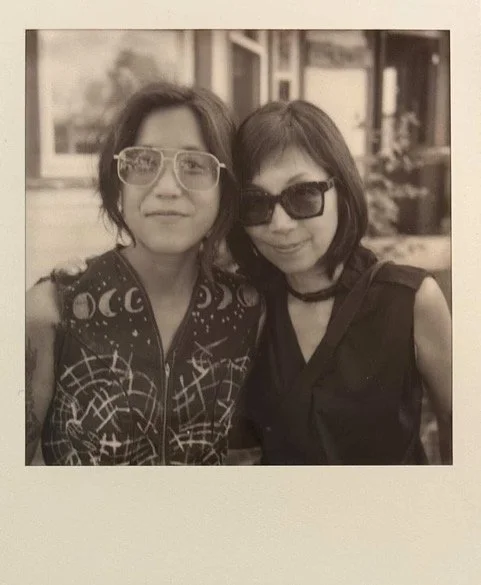
"With Star Route Owner/Director, my goddess Amanda Wong" - Yuka
Yuka Honda:
It's hard to measure, even though I can meet myself anytime. Usually I have a show, so I work towards the show to finish what I have, and then I like to come back to it and develop it. Maybe I listen to my show, I listen to myself recording, and then I edit and edit and edit as well.
My show is usually, let's say it's 40, 45 minutes. It's kind of like an epic journey. I like to go to many places. It's very chaotic and I go through many stages, but I really like to rework and add stuff. And one reason is that if I'm playing the same set over and over, because I'm in electronics, it can get pretty boring. So I like to have a lot of elements that may surprise me. I like to have sounds that I don't really know in my patches. So when I play it, I'm like, "whoa, what do I do with it?!” [all laughing]
And I kind of need to have this thrilling moment in my set so that it's exciting for me…basically my answer is that I may work on it for month and month, but not every day. I come back to it and I work on it and then I do a lot of other things. And then I come back to it. Sometimes I won't play this set for a long time, and a year or two years later, I come back to it and then I modify it to fit me, my current me, and then I play it. So yeah, it's hard to say, but I like to work on it for a long time. It does get better, it feels.
Whitney Johnson:
I'm obsessed with artist studio days, how they orient their studio time, and I wonder, are there elements that need to be in place to give you a good studio day? It could be the schedule, it could be the surroundings, it could be, I mean, just anything. How do you make a great studio day happen?
Yuka Honda:
So, I don't really like recording studios. I like my own studio because I'm in electronics, so my work is half creating but half mixing as well. So I made my studio in a way that I really love. I have my favorite audio converter and I have my favorite studio monitors and it sounds really good. I travel back and forth between the city and the country often, and this time I knew that I was going to be in the city for a long time, so I came with my studio monitors. So when I work here, I can listen to the sound in a way that I like. When I go into the recording studio I often struggle with the sound because, of course, it's different. And I may have to do it with headphones or I may have to use their studio monitors. So I like to go in there really knowing what I'll do. Or at least mostly knowing what I'll do, so I don't have to rely on my intuition. It sounds different and usually I can't really adjust. So even if the situation's a little different, I'll do what I'm supposed to do.
A lot of the studio situation is to also work with engineers that you like. For me, someone who is kind to me when I'm not being able to verbalize what I'm feeling. I need to work with somebody who's patient, because sometimes I'm like, "It's a little bit, uhhh, what is it?"
And if I have someone like, "You have to tell me right now," I'm like, "I can't feel it."
Macie Stewart:
That's the truth.
STONE PIECE live
Yuka Honda:
Yeah. A lot of my music practice was learned to say what I feel in words. And this has been a real journey, especially with my band. I had band members, or I produced albums, and if I need to communicate with musicians, some people really want me to speak just technically and not so much about the emotions. So I learned to speak...I guess I also like to learn people's language, and I like speaking in English, for example, right now. It's challenging, but it's also fun for me. And talking about music is the same thing. So the studio is the time that I have to say it in words. I can't just feel it and do it. I have to also communicate with people who work with me. I don't know if I'm answering your question, Whitney. I think studio days are difficult for me.
I think that's my real answer.
Whitney Johnson:
Yeah, me too. That's probably why I'm so curious.
Yuka Honda:
The environment matters. I think Macie said that you used to think in notes, but now you're really thinking more in how it feels. And I feel the same way. It really matters how it feels. It's overtones, it's the reverb, it's the reflections, it's how the sound is trailing, how much noise the sound has or how clean it is, or I want it to be maybe a little noisy because I need it to feel not so clean for some reason and want it to be fuzzy or I want it to be abstract. And those things have become really important in music.
Lia Kohl:
Well, and the space is also just so much. The space between people. As you said about engineers or collaborators, whether you feel like people are listening to you and willing to go toward you, and how much you have to translate from your actual feeling into technical language, or just whatever other kind of way of talking about this vulnerable thing that we're doing.
Yuka Honda:
Yeah. Vulnerable is the word. Vulnerable, kind of like a baby thing, soft thing, but also it needs to go to the world, so we can't keep them here. We need engineering support, recording engineer support, mixing people support, mastering person to support you, so that this baby can also go out there and do the things that you wanted to do. You have to work with them. And I think it's a really important practice for musicians too, because unless you just want to stay home and play music for yourself. If you want to go out there and do things, you also have to have this process, and it's a great learning experience. I'm still learning how to do it.
Macie Stewart:
Big same. [all laughing]
Lia Kohl:
A good skill for life too.
Macie Stewart:
I suppose you never stop learning.
Yuka Honda:
Which is great. If I knew everything, I think I'd be so bored with life, so I'm thankful.

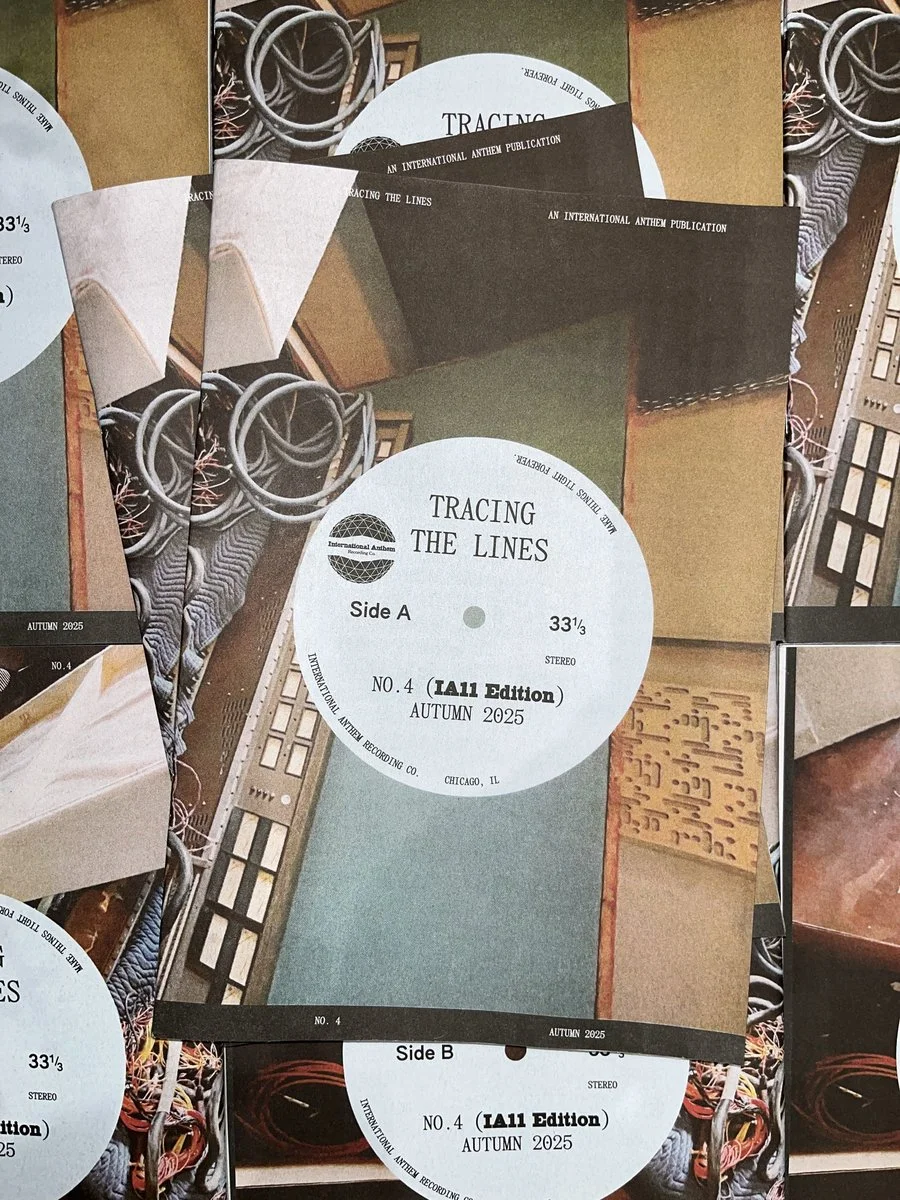
Tracing The Lines is a creative exploration of International Anthem Recording Co. and the community that surrounds it.
Issue #4 is available.
This fourth annual installment (the "IA11 Edition") focuses the lens on a celebration of the label's eleventh year. The IA11 Issue, in turn, acts as the final piece of the celebration, looking back with one eye on the future.